skip to content
Eden Succulents
Tips for Growing Crassula Rupestris

Tips for Growing Crassula Rupestris

Crassula is a succulent genus that belongs to the Crassulaceae family. It has over 350 species and hundreds of hybrids and cultivars. Most Crassulas grow uniquely with leaves stacked upon each other, surrounding the tender central stem which grows stiffer and woodier as the plant matures.
Tips for Growing Crassula Rupestris
Apart from the Crassula Ovata or Jade Plant, the Crassula Rupestris is another common succulent from the Crassula genus. It’s soft succulent that goes by several names including Baby’s Necklace, Necklace Vine, Rosary Plant, Rosary Vine, Kebab Bush, Concertina Plant, Stacking Crassula, and High Voltage.

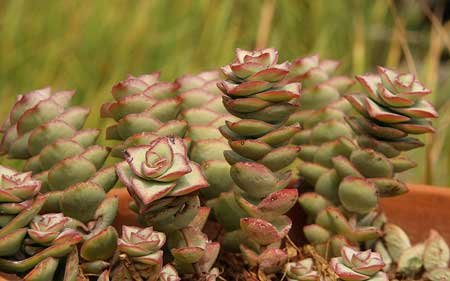
The Crassula Ruperstris is often mistaken for their distant cousin, the Crassula Perforata or String of Buttons, because of their similar features and growth patterns. But the leaves of the Crassula Rupestris are small with a length of barely ¼”, tight, star-shaped, and looks pointier compared to the Crassula perforata.

The leaves of the Crassula rupestris sprawl and grow in a stack formation, and appears spiral around the stem, creating a beautiful intricate pattern. The colour of the leaves is pale green with crimson red edges. The colour intensifies as it gets more sun exposure, which explains why the plant is sometimes called “High Voltage”.

At first, Crassula rupestris grows straight up before it sprawls and appears to spill out of its pot as it matures. It can grow into mounds that are 6 to 10 inches high. In late summer and winter, the plant produces round clustered flowers that look like Baby’s Breath. The blooms of Crassula perforata, on the other hand, are more elongated and protrude outwards. The flowers of both plants come in shades of pale pink or yellow, which adds to their striking appearance.

Caring for Crassula Rupestris

Crassula Rupestris can survive both indoors and outdoors. They will thrive as long as they get the required sunlight and are provided with the right potting mix.

Indoor Care

Provide as much light as possible to your Crassula Rupestris if you plan to put them indoors. Generally, this plant will need approximately 4-6 hours of light every day for it to grow well. If you place it in an area that does not get enough sunlight or has poor indoor lighting, the plant will start to stretch out or elongate. This process is called etiolation, where the plant adjusts itself to seek out better light exposure that it needs to grow. Etiolation makes the plant weak.

When a plant is etiolated, its stems begin to brittle and stops producing new growth because it uses all its nutrients and energy to stretch out. When your Crassula Rupestris seems to be stretching and has uneven internodes (the section of stem between nodes), it means it is not receiving the right amount of light. Move it to a brighter location or a window that faces the east.

Caring for Crassula Rupestris

For indoor areas that have poor lighting conditions or receives no sunlight at all, we recommend using a grow light. A grow light is an artificial light source intended to stimulate a plant’s growth by giving off light required for photosynthesis. It can be used as a primary source of light or a supplemental light for your plants. A grow light is a good investment for your succulent collection, especially when you live in a region that has long, dark winters. We recommend using this grow light for your Crassula Rupestris so it can thrive wherever you place it.

Outdoor Care

Crassula Rupestris will grow best in areas where it can receive plenty of sunlight. It can survive in partial sun to full sun. However, make sure to acclimatized it to the full sun first to prevent sun damage. Crassula Rupestris can tolerate full sun better than the Crassula Perforata, and it reacts to sun exposure by producing pigments that prevent them from burning. These pigments bring out the intense crimson red on the edges of your Crassula Rupestris’ leaves.

When placing your plant outdoors, choose a bright sunny location. But before you expose them to full sun, you need to accustom your plant by gradually increasing the sunlight it receives. Acclimatization is essential to prevent your plant from getting scars on their leaves, which is caused by sun damage. Take note that even when your plant is already acclimatized to the full sun, it can still get sunburned during a heatwave.

During the intense summer heat, you can protect your Crassula Rupestris with the help of sunshades. This easy-to-use Be Grit Sun Shade is made from polyethylene. It is lightweight, durable, and breathable. It is perfect in shading your plant from the intense heat while making sure it gets enough sunlight for photosynthesis.

Hardiness

Because of its origin, Crassula Rupestris are naturally drought tolerant and not frost tolerant, but they can tolerate mild frost and freezing climate for minimal periods. If you are located in the USDA hardiness zones 9-11, you can leave your plant outdoors for the whole year. You can even plant it on the ground.

But if you live in areas with extreme winter conditions, it’s best to grow your plants in containers so you can bring them inside during winters. If you can’t bring them inside, you can still protect them from frost and freezing temperatures with the help of greenhouses and frost covers. Use a frost cover made from fabric, because it provides better insulation than plastic materials.

Soil Requirements

Soil Requirements
Like most succulents, Crassula Rupestris needs a soil that drains well to avoid root rot. Using a 2:1 mixture of cactus potting mix and perlite ensures good drainage. We highly recommend using a sandy soil for added drainage.

Watering Requirements

The watering requirements for Crassula Rupestris depend on the climate where you live. While these plants are drought-tolerant, they will do best when they get a sufficient amount of water.

During the summer months, water your Crassula Rupestris every 7-10 days. Increase the frequency during intense heat. Cut back on watering when the temperature cools down. In the winter season, refrain from watering or hold back from watering altogether.

You don’t need to water your plant as much if you live in a place with a humid climate. It goes the same when your plant is indoors and not getting sufficient light. You do not want your plant to die from root rot.

A good rule of thumb when watering most succulents is to check the moisture of the soil before you water. Make sure that the soil is dried before you water. Water generously, but not too often. If you are not sure with the amount of water to give your succulents, remember that it is better to underwater succulents than to overwater them. Observe how your succulents are growing and adjust your watering techniques accordingly. Be careful not to let water sit on the leaves of your succulent to prevent it from rotting.

If you need further help with watering, we recommend that you use a moisture meter to get accurate measures of soil moisture. This moisture meter is easy-to-use and good for indoor and outdoor use.

Propagation

Propagation
You can easily propagate your Crassula Rupestris through stem cuttings. You can also reproduce it through leaves, but it entails some difficulty.

There you have it! Those are the most important things you have to remember when growing Crassula Rupestris. Keep in mind all the information above so you can help your plant thrives.

Eden Succulents strives to provide the best succulent care guides to ensure that everyone gets to enjoy growing and caring for these gorgeous plants. Please check out our product recommendations and see how they can help you care for your Crassula Rupestris better.

Grow Light, Ankace Upgraded Version 40W Dual Head Timing 36 LED 5 Dimmable Levels Plant Grow Lights

Grow Light, Ankace Upgraded Version 40W Dual Head Timing 36 LED 5 Dimmable Levels Plant Grow Lights

MULTIPLE USES – It is suitable for indoor plant seedlings grown in a hydroponic greenhouse at your home or you placed in your office. It helps to speed up the growth of potted plants, flowering plants, foliage, and succulent plants.
BeGrit Sun Mesh Sunblock Shade Cloth UV Resistant Net

Alluring Aloe Collection of Live Aloe Plants

  • Material: polyethylene; 50% shade rate; The netting is heavy duty, yet very lightweight
  • Easy to use. All 4 sides taped by double stitched with one metal grommet, can be used for flower, vegetable and fruit
  • Lightweight and durability, Mesh and breathable, perfect plant cover, summer shading cover
Plant Frost Protection Winterization Cloth Freeze Blanket Supreme650

Plant Frost Protection Winterization Cloth Freeze Blanket Supreme650

  • Lengthen the harvest time and extends the flowering season
  • This are planters
  • This is manufactured in United States
XLUX T10 Soil Moisture Sensor Meter

XLUX T10 Soil Moisture Sensor Meter

  • WARRANTY– 18 months after the date of purchase, we take care of all quality-related issues with a REPLACEMENT or REFUND
  • EASY TO READ: Large dial, including ten scales, Plug and read.
The Best Low-Light Succulents to Grow Indoors

The Best Low-Light Succulents to Grow Indoors

Most succulents love to get bright, indirect sunlight. However, giving them adequate lighting can be challenging, especially if you live in a place that doesn’t get a lot of natural light. Fortunately, succulents are highly adaptable, so some varieties can still thrive even in the shade.

If you want to grow succulents indoors but you don’t have a proper lighting condition, and you don’t want to use a grow light, you’ve still got options. There are a bunch of succulents that can tolerate low levels of light and will survive with whatever artificial light or ambient sun inside the room.
Below are some succulents that do well in low-light conditions:

Jade Plant

Commonly known as the Crassula Ovata or Money Plant, the Jade Plant is relatively easy to keep indoors. It’s a pretty common variety that is usually found both indoors and outdoors. They look like miniature trees and are very attractive as houseplants.

A Jade plant can grow tall and can reach a height of almost three feet. You might not even recognize that a bush is, in fact, a jade plant when you’re just looking at it from afar.

The Jade Plant is highly resilient; that’s why it can grow big. It can survive harsh conditions with the help of woody stems. Not all succulents are woody and can bounce back from extended periods of not getting enough care and attention. A Jade plant can still recover even after losing all its leaves. Jade plants can live long and are usually passed from generation to generation.

If you’re looking to grow your own Jade Plant, you can buy one here.

Aloe Vera

There’s no doubt about Aloe Vera being the most popular succulent in the whole world. It’s probably the most common houseplant out there. It’s the top plant choice even for people who don’t enjoy gardening.

Aloe vera is very easy to care for, and everyone, even non-gardeners, can grow it. You need to place it somewhere bright with indirect sunlight or artificial light, like near a kitchen window. Remember not to let the sun rays to hit it directly.

Aloe vera is also known to be a medicinal plant. The gel from aloe vera can be applied on the skin to soothe sunburns, and the juice can also be an excellent cleansing drink.

Aloe vera is a very useful succulent that must be grown in every household. If you don’t have one yet, you can get your Aloe Vera here.

Snake Plant

Snake Plant

Also called Sansevieria trifasciata or Mother-In-Law’s Tongue, the Snake Plant is considered the ultimate indoor plant. They are highly resilient and thrive on neglect. You don’t need to worry about them dying because it’s almost impossible to kill them. They can survive with infrequent watering and low to no light conditions.

A Snake Plant has long green leaves that point upwards. Some varieties have yellow edges on their leaves. You can find Snake Plants all over the world, so it’s not very easy to find one to grow in your home. If you want to buy one, you can check some Snake Plants here.

Haworthia

Haworthias are native to South Africa and Southwest Africa. They’re a large genus of dwarf succulents. They are often mistaken as Aloe vera because of their physical similarities. Haworthias form rosettes of fleshy green leaves with white bands that make them distinct from Aloe vera.
This plant thrives in low light conditions and requires infrequent watering. Haworthias are often sold in garden stores, but you can also buy them online.

Burro’s Tail

The Burro’s Tail is known by several other names including Sedum Morganianum and Donkey Tail Plant. It’s a trailing succulent and the easiest to grow among its kind. They do well as indoor hanging plants, and they’re great to put beside the window, on the balcony, or on a patio. Make sure to place your Burro’s tail out of the way as their leaves easily fall off when disturbed. But you can always use the fallen leaves to propagate your plant by putting the leaves on a succulent soil mix.

You can order your Burro’s tail here.

Bear’s Paw

Bear’s Paw, or Cotyledon tomentosa, is a shrublet that grows up to 30cm tall. It has fleshy, lime green leaves that are covered with tiny white hairs, which lend the plant a velvety look. Some of its leaves have one to three apical teeth that resemble a bear’s paw.

Bear’s Paw loves bright, shaded areas where it doesn’t get much direct sunlight. It has an unusual growth pattern, so you won’t easily notice if it’s etiolated. A Bear’s Paw blooms in late spring, producing clusters of bell-shaped flowers in yellow and orange hues.

Purchase your very own furry plant here.

Ponytail Palm

Despite its name and appearance, the Ponytail Palm is not a real palm. It’s a succulent native to Mexico. It stores water in its cute little chubby waist. It’s slow-growing and low-maintenance. When grown indoors, its leaves can grow to 3 feet long.

The Ponytail Palm is perfect if you’re looking for a leafy plant for your indoor space. It’s easy to care for, and the only problem you’ll likely to face is having to refrain from watering it too often.

The Ponytail Palm is not a very common succulent, so it can be challenging to find. But it’s relatively easy to get one online.

Holiday Cacti

Holiday Cacti

The Holiday Cacti is a group of plants that include the Christmas Cactus, Thanksgiving Cactus, and Easter Cactus that all belong to the Schlumbergera genus. These three plants were named according to the time of the year that they bloom. They are all easy to grow and have similar growth patterns and care requirements.

The Holiday Cacti are not drought-tolerant, and they tend to require more water than other succulents. They prefer nights and cold temperatures.
You can get your Holiday Cacti here.

Hoya

The Hoya plant is often called Wax Plant because of its thick, waxy leaves. It’s a tropical indoor plant native to Southern India, East Asia and Australia. It’s a highly resilient succulent that does not require direct light. They are not cold hardy, so make sure to protect them from the frost.

Hoya plants are usually grown in hanging basket and place inside the home. They produce beautiful star-shaped flowers that make them more attractive.

Buy your Hoya from here.

Having a lush and vibrant succulent inside your home is achievable, thanks to these low-light loving succulents. If you’re still looking for the best indoor plant, please check the links we included so you can have your succulents delivered right on your doorstep.

What other succulents do you grow? We’d love to hear your experience with growing them!

Crassula ovata 'Jade Plant'

Crassula ovata 'Jade Plant'

Live Arrival Guarantee (when temps are above 20°F and below 85°F)
Alluring Aloe Collection of Live Aloe Plants

Alluring Aloe Collection of Live Aloe Plants

INCLUDED IN PURCHASE | (3) Aloe Vera plant. Each plant may vary from pictures shown as succulents are hand selected based on season, size, health, and readiness.
AMERICAN PLANT EXCHANGE Sansevieria Trifasciata Snake Laurentii Live Plant

AMERICAN PLANT EXCHANGE Sansevieria Trifasciata Snake Laurentii Live Plant

Sansevieria, or the mother-in-law’s Tongue/ snake plant as it’s commonly known is a truly remarkable and striking easy Care houseplant. They seem to be indestructible house plants that never seem to die, or need fertilizer or water.
Shop Succulents Burrito Sedum Succulent Plant

Shop Succulents Burrito Sedum Succulent Plant

INCLUDED IN PURCHASE | (1) Hanging Burrito Sedum in 6″ pot. Each plant may vary from pictures shown as plants are hand selected based on season, size, health, and readiness.
A Comprehensive Care Guide for Climbing Aloe

A Comprehensive Care Guide for Climbing Aloe

The Climbing Aloe or Aloiampelos ciliaris is a rapid-growing Aloe formerly known as Aloe ciliaris. It’s native to the tropical regions of South Africa. The Climbing Aloe is reed-stemmed and has long, flexible leaves with somewhat pointed edges. In the wild, the Climbing Aloe branch and climbs like a vine and grows into a medium-sized brush. It can reach a height of over 12”. It stays small when grown indoors.

The Climbing Aloe can be differentiated from other species of Aloiampelos by its appearance. The soft, white hair-like teeth that grow along the margins of the leaves of the Climbing Aloe extend to the stem. It has lime green fleshy leaves that are distinctly recurved. The leaf sheaths or the structure at the base of the leaf petiole that surrounds and protects the stem, are prominently striped green and white.

A unique characteristic of the Climbing Aloe is that it grows pretty rapidly, and it’s almost impossible to kill. The roots are fleshy and swallow. The long and untidy stems shoot upwards and produce large, deep orange hanging flowers that look like tubes and are angled downwards. The Climbing Aloe blooms almost throughout the year, but mostly during spring. The fruits that the flowers produce are about 18mm long and in what looks like oblong capsules.

Aloiampelos ciliaris ‘Climbing Aloe” Care

A Climbing Aloe can thrive both indoors and outdoors as long as you provide them with the appropriate potting mix and the right amount of sunlight.

Indoor Lighting Requirements

When growing your Climbing Aloe indoors, place it in a bright location. It grows best in filtered sun or partial shade, so it will thrive if you put it beside a window that faces the east. A window that faces the south or the west will also give it the bright light it requires. Poor lighting and overwatering can cause your plant to die early. Move your succulent around your house to find the best location that will provide its lighting needs.

If your Climbing Aloe is located in an area that doesn’t get sufficient light throughout the year, don’t worry! You can still make it grow by using artificial light or a grow light. Grow lights can supply your Climbing Aloe’s lighting requirements, and can be especially useful during the winter months. We recommend that you use this LED grow light because it will speed up the growth of your succulent plant. It is suitable for use inside your home and even in the office.

Outdoor Lighting Requirements

The Climbing Aloe requires partial sunlight or bright indoor light; in fact, it can tolerate more shade compared to other aloes. It can also tolerate full sun.
Outdoor Lighting Requirements

Before you move the plant outdoors or increase the level of sunlight it receives, we suggest that you acclimatize it first to prevent sun damage or sunburn. Gradually increase the amount of sunlight it gets until it becomes fully acclimatized to the sun. It’s important to note that even your Climbing Aloe is already acclimatized to full sun, it can still suffer from sun damage or sunburn, especially when there is a heatwave or during intense heat. So, make sure to protect your Climbing Aloe, especially the smaller ones, because they are less tolerant of the weather.

To ensure that your Climbing Aloes are protected adequately from intense heat, consider using shade cloths. Shade cloths can efficiently preserve your plants, especially the young ones, from direct sunlight. This UV resistant sun mesh shade can block intense sunlight and heat while still allowing air to flow through, creating a cool, shaded area for your succulents.

Cold Hardiness

The Climbing Aloe is a soft succulent, meaning it will not survive a hard frost. However, it can tolerate a mild frost and freezing temperatures as long as they are not exposed to the condition for too long. If you live in USA Zone Hardiness Zone 9a to 11b, you can leave your Climbing Aloe outdoors.

If you live in an area where the cold months are long and dark, it’s best to grow your Climbing Aloe in a container so you can bring it indoors when there is a snow forecast or when the temperature drops to below 30F. If there is no way for you to bring your Climbing Aloe indoors when the temperature is freezing outdoors, there is still a way for you to help your plant live through the cold months.

You can use frost cloth or a mini greenhouse to protect your plants from the harsh temperature. A mini greenhouse can help shield your succulent from the chill of spring and fall. This portable pop-up greenhouse is relatively easy and quick to install. It can be put up in seconds and is excellent for use both indoors and outdoors.

Cold Hardiness

Soil Requirements

All succulents, including the Climbing Aloe, need well-draining soil and a proper watering technique to make it grow. Succulents are prone to root rot, and one way to avoid this is to provide them with the right kind of soil. Good soil is also essential, especially if you are still unsure how often and how much water to give to your succulents.

The right soil mix contains 50% to 70% mineral grit and is composed of coarse sand, pumice, or perlite. It is also essential to plant your Climbing Aloe in a container with well-draining holes, so your plant doesn’t sit on wet soil too long.

Watering Requirements

The watering techniques for Climbing Aloe depends on where you live. While they are drought-tolerant, they appear greener and lusher when given sufficient amounts of water. And underwatered Climbing Aloe will turn chocolate brown-colored.

There is no recommended fixed schedule in watering a Climbing Aloe. A general rule in watering all succulents is to water them until water comes out from the drainage holes, and the wait for their soil to be fully dry before watering them again.

If you live somewhere humid, you won’t need to water your succulent as much. It goes the same when you’re growing your Climbing Aloe indoors, especially if they’re not getting a lot of light. Adjust your watering techniques according to the light that your Climbing Aloe receives.

Propagation

Leaf propagation is not possible for Climbing Aloe. You can propagate it through seeds or stem cuttings. If you’re looking to grow this succulent, you can buy it here.

The Climbing Aloe is an excellent choice for succulent growers who do not have much experience with gardening or those who want to have a low-maintenance garden. They are not complicated to grow, and they don’t die quickly. Make sure to check out all our product recommendations that can aid you in caring for your Climbing Aloe. If you have any tips for growing and caring for Climbing Aloe, please let us know in the comments box below!

Grow Light, Ankace Upgraded Version 40W Dual Head Timing 36 LED 5 Dimmable Levels Plant Grow Lights

Grow Light, Ankace Upgraded Version 40W Dual Head Timing 36 LED 5 Dimmable Levels Plant Grow Lights

MULTIPLE USES – It is suitable for indoor plant seedlings grown in a hydroponic greenhouse at your home or you placed in your office. It helps to speed up the growth of potted plants, flowering plants, foliage, and succulent plants.
Sun Mesh Shade Sunblock Shade UV Resistant Net

Sun Mesh Shade Sunblock Shade UV Resistant Net

  • Approximately 40-55% shade rate and can be used for flower,vegetable and fruit.
  • It will have no affect for photosynthesis and is more suitable for blocking the sunlight and heat while air can still flow through.
Mini Pop up Greenhouse Small Indoor Outdoor Gardening Flowerpot

Mini Pop up Greenhouse Small Indoor Outdoor Gardening Flowerpot

Portable pop up greenhouse . Easy and qucik install. This small vegetable garden plant greenhouses cover can be set up in seconds and great for either indoor or outdoor growing
What Are The Different Types Of Succulents That You Can Grow?

What Are The Different Types Of Succulents That You Can Grow?

Succulents have taken over the world. These are now often seen in gardens, terrariums, as indoor plant decorations, and can be planted in hanging planters. Succulent growing is a popular trend and a lot of plant cultivators prefer growing them over other plants because they can thrive in desert-like climates which can easily be mimicked indoors, in the safety of your homes.

Some succulents come from dry, arid climates such as Africa and Central America where it is hot and there is little to no humidity. Succulents can survive in dry and hot areas because they are known to store water in their leaves which allows them to withstand hot temperatures and survive with little to no watering.

Succulents are perfect for forgetful home gardeners because they can survive with low maintenance. If you are always away for work or travel a lot and have no time to take care of plants but still want to see cute and lovely plants at home, a succulent plant is the right choice for you.

Do you know how many types of succulents are available in the wild? In this article, we will be discussing the different types of succulents that you can grow. If you want to know more information, make sure to read on below.

1. Ladyfinger Cactus (Mamilliaria elongata). This is one of the most common species of cactus that can be grown indoors. It is easy to propagate, as it creates a new baby cactus every time. When the baby cactus has grown a bit, it can be transferred or transplanted in a different container.

The baby cactus may take a while for its roots to grow. If you choose to grow this succulent, make sure it gets enough sunlight. You can plant your ladyfinger cactus in a container and place it on a windowsill. If it does not get enough bright light, there is a tendency that it will grow tall and become stretchy.

Ladyfinger Cactus
2. Flaming Katy (Kalanchie blossfeldiana). This succulent is a native plant found in Madagascar. It grows in areas with temperatures that range from 60 to 85 degrees. It is excessively sensitive to cold, so make sure to take it inside when the cold weather comes. You can grow your Flaming Katy in clay pots with drainage holes at the bottom like this.

When growing this plant, keep in mind that they prefer bright areas and will bloom more flowers when exposed to the sun 8-10 hours per day. During late autumn or early winter, the Flaming Katy blooms buds that have four petals with colors that range from dark red, white, and gold. You can use this succulent as a table centerpiece decoration or a great addition to your succulent collection.

You can use this succulent as a table centerpiece decoration or a great addition to your succulent collection.

3. Acanthocalycium thionanthum (Echinopsis thionantha). It commonly grows in Argentina and in areas which are found in 1300-1500 meters above sea level. This succulent is usually grown as a solitary plant and will sometimes slowly branch out through its basal shoots. If you are planning to grow this plant, make sure to expose it in the full sun to maintain the plant’s compact form with colorful and strong spines.

If not exposed enough to the sun, it will become elongated. While it remains green, it will not exhibit its usual powdery-grey coating. Use a pot with drainage holes and cactus soil. This plant must be watered during summer, but make sure to keep it dry during the wintertime. It is somewhat frost-hardy as long as you keep it dry before and during the winter months.

It blooms flowers with colors that range from white, yellow, pink, orange, or red. It can be grown as an indoor plant because it blooms beautiful flowers, just make sure it gets enough sunlight every day. You can also use grow lights like this if growing it indoors.

4. Common Glasswort (Salicornia europaea). It is also known as Sea Asparagus or Poor Man’s Asparagus. This lovely plant is an annual succulent and it is safe to eat. It can be eaten like any other vegetables in your garden; you can try it as it is quite tasty, especially when it is pickled. The common glasswort is commonly found in beaches and salt marshes and usually forms green, fleshy carpets.

It grows up to 16 inches and produces flowers during late summer and the seeds ripen in the fall. It may be a bit challenging to grow in gardens, but you can be successful by sowing seeds once they mature during fall. When planting this succulent, it needs rich organic, well-draining soil. It also needs an adequate amount of nitrogen and regular watering to grow well.

Common Glasswort

5. Split Rock (Pleiospilos nelii). A native plant found in South Africa, this succulent is commonly confused with Lithops because they look similar to each other. Both plants belong in the Mesemb family, where the plants resemble rocks instead of plants. The split rock succulent grows and sits low to the ground. Usually, some leaves of the plant are buried in the soil.

Some species have transparent window-like leaves that allow light to enter the plant even when it is buried in the soil. The split rock grows in desert-like climates and they prefer getting lots of sun exposure, so you can place it in a south-facing window. When growing this unique-looking plant, avoid overwatering it!

Avoid planting it with other succulents, it is best to grow it on its own. You can plant it in a terracotta container and decorate it with pumice stones. This succulent blooms in the mid-afternoon and closes its petals during dusk, repeating this occurrence for a few days and if pollinated by bees or butterflies, it will proceed to become dry and create a seed pod that can be used to propagate a new plant.

6. Roseum (Sedum spurium). This succulent grows low in the ground. It usually grows up to 4-6 inches in height. It grows fast and can be planted in planters or containers on a windowsill. It blooms pale-pink flowers during summertime, making it a perfect choice if you want to add a pop of color to your indoor decorations. It can also be added to floral arrangements.

When growing this plant, always remember that it grows in areas exposed to full sun and areas with partial shade. You can grow it in a windowsill so it can get enough sunlight daily. This plant is quite hardy; it can grow in poor soil conditions and can tolerate extremely low temperatures and drought-like conditions.

7. Bunny Ear Cactus (Opuntia microdasys). It belongs to the Opuntia genus and it is a native plant of Mexico. It grows fast, with new cactus pads popping up at the same time which resembles rabbit ears. Be careful when dealing with this succulent because it has tiny hairs also known as glochids, that can cause skin irritation and can be quite difficult to remove when it attaches to the skin.

Proceed with caution especially if you have small kids and pets. If you decide to grow this succulent, you must place it in an area where no one can accidentally bump into it. When growing this plant, you must know that it prefers dry, low humidity areas and needs plenty of sunlight exposure. It grows slowly indoors, can reach up to 2 feet tall and same width. It can be planted in a container.

It rarely produces flowers but if it does it usually produces 2-inch creamy yellow flowers during summertime, and then followed by round purple fruits. The bunny ear pads that grow can be used to propagate this plant just be careful when dealing with it because its glochids can penetrate the skin, you can use gloves and plant it in a well-draining container.

Bunny Ear Cactus

8. Pig’s Ear (Cotyledon orbiculata). This succulent has thick oval leaves and has red color on its edges, bearing a resemblance to a pig’s ear. It blooms yellow and red flowers on the top of its 2-foot stems during late summer or early autumn. The pig’s ear succulent can grow up to 4 feet high, making it a perfect plant to add in your outdoor succulent garden.

It grows best in dry areas; you can also add it in rock gardens or hanging planters. When growing this plant you must know it does not need a lot of watering but it will take up a large amount of space, so make sure to leave an ample amount of space when planting it in your garden.

9. Key Lime Pie (Adromischus cristatus). A native plant of South Africa, this plant is also known as the Crinkle Leaf Plant. This plant is low-maintenance and it does not need too much sunlight for it to grow properly and it needs well-draining soil. It can be mixed with other succulents and can be grown in indoor succulent gardens. Before watering it, allow the soil to become dry completely and do not leave this plant outside as it needs protection from frost during wintertime. This plant produces white tubular flowers during the spring to summer months.

10. Sweetheart Hoya (Hoya kerii). This cute and lovely succulent plant is a perfect Valentine’s Day or anniversary gift to your special someone. It has thick, heart-shaped leaves and it is a low-maintenance indoor plant. It grows slowly and it can be planted in a hanging basket. Mature plants in the wild can grow up to 13 feet tall.

It blooms clusters of white flowers with a burgundy center during summertime. If the Sweetheart hoya is fully mature, it can produce up to 25 flowers. It will need bright, indirect sunlight to produce flowers. It is drought-tolerant and can survive with at least 1-2 watering per month.

Avoid over watering as it can cause the plant to rot. You can use this watering can to prevent overwatering. If you are planning to grow it indoors, make sure to maintain room temperature between 60-80 degrees Fahrenheit or 15-26 degrees Celsius.

Sweetheart Hoya
If you are planning to grow different types of succulents in your home, make sure to check out the list we have mentioned above. Succulents are usually drought tolerant and can be easy to care for.

If you are often away from home or you have a busy lifestyle, succulent plants are the perfect plants for you to care for. They require little maintenance and attention and can be used as a great addition to your indoor decoration or as an outdoor plant and be added to your garden landscape.

Are you searching for the different types of succulents that you can grow? You came to the right place! Here at Eden Succulents, we will teach you the different information about succulents. If you need more information and you need guides on how to care for and grow succulents, you should check out the rest of our site’s store of information. If you have any suggestions, comments, questions, or inquiries please do not hesitate to contact us. We’d love to hear your thoughts!

Terracotta Pot Clay Pots 4'' Clay Ceramic Pottery Planter Cactus Flower Pots

Terracotta Pot Clay Pots 4'' Clay Ceramic Pottery Planter Cactus Flower Pots

  • High quality terracotta,High fired, Smooth texture
  • Size of Pots are approximately 4″ Tall with a 4″ Top Outside Diameter
Astrophytum Asterias Nudun sand dollar cacti rare flower cactus seed

Espoma Organic CA8-4 8QT Cactus Pot Mix

  • Size: 8 Quart
  • Specifically formulated to the special needs oc cactus
  • Palm & succulents
Potey Terracotta Flower Pot Clay Planter

Potey Terracotta Flower Pot Clay Planter

【TERRACOTTA】Matte finish is perfect for resisting scratches, dirt, and fingerprint. Small clay pot is suitable for seedling and small plant as succulents,cactus,herbs,amaryllis bulbs, Placing plants with terracotta succulent planter also adds character, purify the air, and bring so much positivity.
White Ceramic Succulent Planter Pots

White Ceramic Succulent Planter Pots

Burpee Organic Premium growing mix is enriched with Burpee plant food for vibrant flowers and delicious vegetables and herbs
Rare Succulents That You Need To Know About

Rare Succulents That You Need To Know About

There are lots of different succulent types available in the wild that are currently grown in gardens by plant lovers. There are rare succulents that exist in the wild that look quite different and unique compared to the common succulents found in the garden.

Rare succulents are difficult to care for and can be difficult to find commercially. These varieties are usually hard to grow or do not root easily. Some succulents can fail to produce seeds or can be difficult to propagate because they are capable of producing only a few offsets. Tissue culture has been used to cultivate rare succulents and growing them has now become a reality.

Searching for rare succulents can be quite difficult, and if you want to know more about them, you came to the right place. Here at Eden Succulents, we will be discussing the rare succulents that you need to know about. If you want to know more information, make sure to continue to read below.

Rare Succulents That You Need To Know About
There are lots of different succulent types available in the wild that are currently grown in gardens by plant lovers. There are rare succulents that exist in the wild that look quite different and unique compared to the common succulents found in the garden.

Rare succulents are difficult to care for and can be difficult to find commercially. These varieties are usually hard to grow or do not root easily. Some succulents can fail to produce seeds or can be difficult to propagate because they are capable of producing only a few offsets. Tissue culture has been used to cultivate rare succulents and growing them has now become a reality.

Searching for rare succulents can be quite difficult, and if you want to know more about them, you came to the right place. Here at Eden Succulents, we will be discussing the rare succulents that you need to know about. If you want to know more information, make sure to continue to read below.

Rare Succulents That You Need To Know About

1. Ruby Necklace (Othonna capensis). Its common name is “Little Pickles”. It belongs to the genus Othonna that comes from Africa. The Ruby Necklace has reddish-purple stems and pale, greenish-pink leaves. This succulent plant is commonly used and grown for its trailing properties. It grows all year long, can spread very fast, and produces flowers that look like daisy flowers.

If this plant is grown in low light areas, they will have a green color and purple highlights on the stem. on the other hand, if exposed to the bright sunlight, its stems and leaves will turn into ruby red. If you are planning to grow this succulent, you can plant it in a hanging planter outdoors.

2. Sand Dollar Cactus (Astrophytum asterias). It is commonly found in Mexico, as well as in Texas, USA, this plant is also known as star cactus or sea urchin cactus. This succulent is a rare succulent with no spines. It has become a popular houseplant since it was first introduced in the mid-1800s.

Since the sand dollar cactus became popular, it is now vulnerable and a lot of individuals are removing them illegally and mailing them to different parts of the country, some illegally selling them to buyers. Since 2015, there have been approximately 2000 sand dollar cacti left in the wild. If you are planning to grow this succulent, it has been discouraged to get this plant from the wild, as it can be easily grown from seeds and cuttings. Get your sand dollar cactus seeds here.

3. Little Jewel (Pachyphytum compactum). This succulent has short stems and produces a compact rosette at its crown. This plant has grey-white leaves with white veins and purplish tips. It blooms pale-yellow flowers while the rest of the flower has a pinkish-orange color which is found in the center of the plant.

This plant can thrive even if exposed to extremely high temperatures and direct sunlight. It is not frost-hardy as it can die in temperatures below -6 degrees Celsius or 21.2 degrees Fahrenheit. Make sure to bring it inside when the winter months come.

This succulent can grow in poor soil conditions just make sure to use containers with drainage holes. You can place it in areas with full or partial sunlight. Use this soil because it is perfect for succulents. It can prevent root rot, has perfect pH balance and it is pathogen-free. When watering this plant, make sure to avoid over-watering. Before watering the plant, you must allow the soil to completely dry out.

Little Jewel

4. Living Pebbles (Conophytum subglobosum). This succulent looks like Lithops and it is commonly found in Africa. This plant just like the Lithops succulent also belongs to the mesemb family. Although the living pebbles plant is rare, it is not too difficult to care for.

A stemless plant, this succulent grows slowly and produces tiny flowers with spidery petals. The living pebbles is a perennial plant and forms pea-shaped heads. If you are growing this plant, it needs a small amount of watering and must be exposed in full sunlight or partial shade. You can use this garden syringe when watering this plant.

Living pebbles are winter-growing succulents. They are commonly found in dry areas or crevices. They are also known as rock dwellers. They usually grow in east, south, or west rocky areas or slopes. They can be found growing in mosses and other shade-loving plants. This succulent produces flowers that can be pollinated by nocturnal moths.

5. Living Rock Cactus (Ariocarpus trigonus). This plant is one of the 8 different species that belong to the Ariocarpus genus. This succulent is not a cactus, it matures slowly. It blooms yellowish-white flowers with red mid-ribs that circles the whole plant. It is low-lying succulent and grows near the ground; it grows up to 10-inches in height and 12-inches in width.

This plant can grow in a well-draining succulent/cactus soil mix. This plant needs plenty of sunlight exposure. Just make sure to avoid exposing it in excessively hot temperatures. You can use shade cloth or you can plant your living rock cactus in a container so you can move the plant during the hottest hours of the day.

If you live in areas with low humidity and room temperature, you can easily grow this plant. You can water the succulent when the soil is thoroughly dry. Avoid watering the living rock cactus during wintertime. You can also use pumice stones to allow the faster draining of water.

6. Salao (Aeonium gorgoneum). It is commonly found in the Cape Verde islands. This plant is a rare succulent. This plant belongs to the Crassulaceae family and it is shaped like mermaids. It is often used as a traditional/herbal medicine to treat cough, bronchitis, and other medical problems.

According to the IUCN Red List, there are less than 1000 plants left in the wild. It is drought-tolerant and has light green-yellow leaves with a pink tinge if exposed to strong light levels. You can use the terracotta container if you are planning to grow this plant in your garden.

Salao

7. Pelotilla de Chinamada (Monanthes wildpretii). This plant is a rare succulent; it is known to only grow on the island of Tenerife, in the Canary Islands, Spain. This succulent only grows in an area that is only about 1 km² in size. It commonly grows in crevices and fissures and tends to grow near other succulents that belong from the Monanthes genus.

It has a small population due to the reason that it grows in a frequently traveled road. This succulent is quite rare and there are only around 600 plants left in the wild because its habitat has been degraded over the years. It has been made vulnerable because it has been collected and sold as a rare succulent.

8. Paper Spine Cactus (Tephracactus articulatus). The paper spine cactus is a native plant found in Argentina. This plant is a bushy succulent and grows slowly up to 30 cm tall. The segments of the plant which are pine cone-shaped can easily fall off because they are loosely attached. It has flat papery spines thus the name “Paper Spine Cactus”. It produces white bell-shaped flowers with a yellow center and a diameter of 4 cm or 1.6 inches.

The paper spine cactus needs a small amount of water and can be exposed to plenty of sunlight. It is easy to propagate; you can use seeds or cuttings, making it a favorite among succulent growers.

This plant can be planted in dry, hot, arid climates and can even survive temperatures up to 15 degrees Fahrenheit. They can be planted and left alone outdoors, you can also plant the paper spine cactus in a container. You can repot this plant using potting soil. The paper spine cactus can be added in desert-inspired gardens or xeriscapes.

Paper Spine Cactus

9. Haworthia truncata v. maughanii. The Haworthia truncate plant is considered as a rare succulent. Like the other haworthia species, this plant has a very unusual appearance. This plant is unique because it has transparent “windows” at the tip of its leaves.

The leaves of this plant grow in different patterns and can grow in different ways like under, over, or around other leaves. Every plant is different from each other. This plant has a snowflake design on its apex; the leaves resemble a fan with a wart-like surface and a transparent end. The rosettes are medium-sized, it does not have stems and grows slowly. The haworthia succulent is easy to propagate and cultivate, although it grows slowly, so you wait patiently for it to produce attractive heads.

This succulent prefers growing in sandy-gritty soil and it must be well-draining because the haworthia is prone to root rot. During the dry season, you must water it regularly using this watering can. You can place this plant in shaded areas, especially during summertime.

10. Vahondrandra (Aloe helenae). This plant is a perennial plant and it is considered as one of the endangered succulents. It is a native plant found in southern parts of Madagascar. There are around approximately 200-500 Vahondrandra succulents left in the wild and there is a great possibility that the population continues to decrease.

The main reason why it is considered an endangered succulent is because of the destruction of its habitat and it has been used for mining and agriculture purposes. This plant is drought-tolerant and can be repotted. You can also plant seeds in sandy soil. The seeds can germinate in a matter of few weeks, and it must be placed in areas with temperatures around 68-75 degrees Fahrenheit.

Once the seedlings sprout, it must be planted in well-draining soil and it must be kept moist to keep it growing properly. The vahondrandra produces 1-2 inches red to pale yellow flowers during late spring or early summer. This plant needs full sun exposure and can grow up to 12 feet in the wild.

Vahondrandra
Make sure to check the list of rare succulents we have mentioned above, if you know more rare succulents please let us know, we would like to hear from you!

Are you planning to grow different succulent plants in your home? Do you know any rare succulents that we might have missed? Eden Succulents is the best place for you to learn and know all the things about succulents. If you need any information or guide about caring and growing succulents, check out our website.

Our love for succulents allows us to share all the information we know about succulents. Our goal is to learn more information about succulents every day so if you have any comments or suggestions we would like to hear from you! We are always willing to help you out!

Fox & Fern 11" Hanging Planter Geometric Polystone

Fox & Fern 11" Hanging Planter Geometric Polystone

HANGING GEOMETRIC PLANTER. 11″ in Diameter, 5″ in Height and 27″ Height when hanging
Astrophytum Asterias Nudun sand dollar cacti rare flower cactus seed

Astrophytum Asterias Nudun sand dollar cacti rare flower cactus seed

Astrophytum Asterias Nudun sand dollar cacti rare flower cactus seed 30 SEEDS
Bonsai Jack Universal Organic Bonsai Soil Mix

Bonsai Jack Universal Organic Bonsai Soil Mix

  • Screened and pre-washed mix. Optimal pH of 6.4
  • Available in bag sizes from 2 quart to 28 gallons.
  • Optimized for pH, water absorption, evaporation, bulk density and particle size.
Burpee Organic Premium Potting Mix

Burpee Organic Premium Potting Mix

Burpee Organic Premium growing mix is enriched with Burpee plant food for vibrant flowers and delicious vegetables and herbs